In many organizations, it quietly slips through the cracks due to unresolved internal issues. Missed handovers, unclear processes, low morale, and operational friction all add up over time. These problems rarely make headlines inside a company, but their financial impact can be significant.
One of the most effective ways to detect and recover this lost revenue is often overlooked: employee feedback. While organizations invest heavily in systems, analytics, and performance metrics, they sometimes fail to listen closely to the people who work within those systems every day.
Employees sit closest to daily operations. They see inefficiencies as they happen. They experience customer pain points before those issues show up in reports or dashboards. When feedback is ignored or collected without action, organizations lose more than trust. They lose money, momentum, and opportunities for improvement.
Employee feedback is not just an HR activity or a culture initiative. When handled correctly, it becomes a strategic signal system. Frontline employees often know where delays occur, why customers churn, or which processes slow down delivery. These insights are grounded in real experience and day-to-day observation, making them especially valuable.
In many cases, employees adapt to broken processes quietly. They find workarounds, compensate for gaps, or absorb inefficiencies without formally raising concerns. While this keeps operations running in the short term, it hides deeper problems that continue to affect cost, quality, and customer satisfaction.
The problem is not the lack of feedback. Most organizations already collect surveys, conduct reviews, or run engagement initiatives. The real challenge lies in what happens next. When feedback does not lead to visible action, employees stop sharing meaningful insights. Overtime, responses become generic, participation declines, and valuable signals are lost. That silence can be costly.
An open feedback loop is one where employees share input, but no clear response follows. While feedback may be acknowledged in theory, there is little clarity on what is being done with it. Over time, this creates frustration and disengagement. Employees feel unheard. Managers lose access to honest insights. Problems remain unresolved.
From a revenue perspective, this can mean repeated operational errors, declining service quality, and preventable customer dissatisfaction. Issues such as delayed responses, inconsistent delivery, or unclear ownership often stem from internal misalignment that employees are already aware of.
These challenges rarely trigger immediate alarms. Instead, they slowly drain productivity and profit. Costs rise due to rework, customers lose confidence, and teams become reactive rather than proactive. Without closing the loop, organizations risk normalizing inefficiency.
Closing the feedback loop means acknowledging input, acting on it, and communicating outcomes clearly. This process turns feedback into a recovery mechanism rather than a formality.
When organizations actively close feedback loops, something interesting happens. Small operational fixes start preventing larger losses. Teams become more proactive. Employees begin highlighting risks early instead of reacting late.
For example, feedback from a warehouse team about recurring delays might reveal a process flaw that impacts order fulfilment. Addressing it early avoids customer complaints and potential contract losses. Similarly, insights from customer support staff can expose billing issues, communication gaps, or service inconsistencies that directly affect revenue.
What makes this approach effective is its simplicity. Rather than relying solely on top-down initiatives, organizations tap into existing knowledge within their teams. Employees are no longer just executors of tasks, but contributors to improvement.
The value does not come from feedback alone, but from structured follow-through. Without action, even the most accurate insights lose their impact.
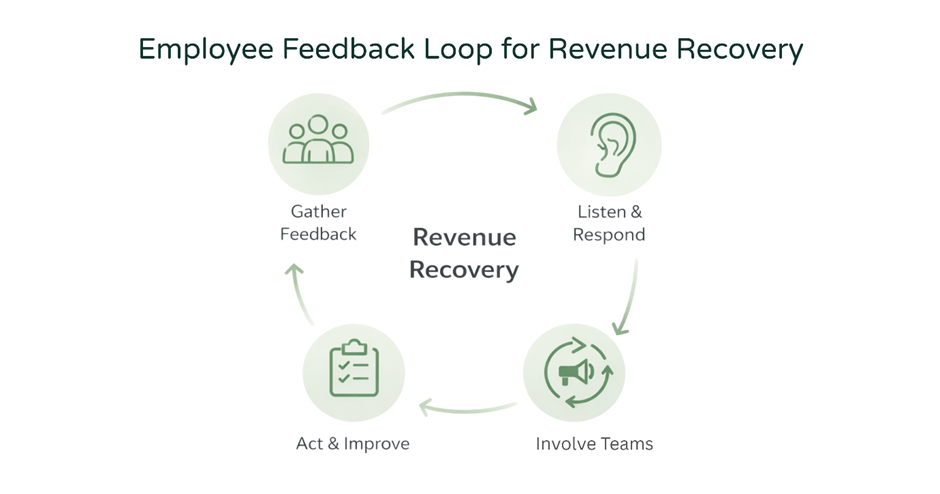
Closing the feedback loop should not be treated as a onetime response to employee input. It works best when it becomes a continuous practice embedded into everyday operations. When teams know that feedback is reviewed regularly and followed up consistently, they are more likely to share insights early and honestly.
Over time, this consistency creates momentum. Employees stop seeing feedback as a formality and start viewing it as a meaningful part of decision-making. Small improvements compound, processes become smoother, and fewer issues escalate into costly problems.
This ongoing loop helps organizations stay ahead of inefficiencies rather than constantly reacting to them. It also encourages learning. Each cycle of feedback and action builds greater awareness of what works and what does not.
Importantly, closing the loop does not require complex systems or heavy processes. Often, it is about clarity and follow-through. A simple acknowledgment, a shared update, or a visible change can reinforce trust and encourage continued participation. When employees see progress, even incremental, they remain engaged in identifying what can be improved next.
To recover revenue through employee feedback, organizations need to move beyond annual surveys and one-off check-ins. While these tools have their place, they are often too infrequent to capture emerging issues. Feedback must be timely, contextual, and easy to act upon.
This starts with creating clear channels where employees feel safe sharing honest input. Psychological safety plays a key role here. When employees trust that their feedback will not lead to negative consequences, they are more likely to raise concerns early.
It continues with assigning ownership for reviewing feedback and prioritizing actions. Without clear responsibility, feedback risks being overlooked or delayed. Most
importantly, it requires closing the loop by informing employees about what changed and why.
When employees see their feedback leading to improvements, participation becomes more meaningful. Trust grows, and insights become sharper. Over time, feedback quality improves, making it an even more powerful tool for operational and financial decision-making.
Leadership plays a critical role in whether feedback becomes a growth driver or a missed opportunity. Leaders who actively listen, ask follow-up questions, and communicate decisions set the tone for the entire organization.
Closing the loop does not always mean implementing every suggestion. It means explaining decisions transparently. Even when feedback cannot be acted upon immediately, acknowledgment matters. It reassures employees that their voices influence outcomes.
Leaders who model this behaviour create an environment where feedback is seen as valuable rather than risky. Over time, this approach builds a culture where problems are addressed early, long before they impact revenue.
Organizations that treat employee feedback as an operational asset gain a competitive advantage. They detect inefficiencies faster. They reduce avoidable losses. They strengthen alignment between teams and goals.
When insights are connected to execution, organizations do more than improve engagement. They protect and recover revenue. Feedback becomes part of a broader system of learning and improvement rather than a standalone activity.
This shift from insight to impact is what differentiates organizations that merely listen from those that act.
Revenue recovery does not always come from new strategies or tighter spending. Sometimes, it starts by listening more closely to the people already inside the organization.
Employee feedback, when respected and acted upon, becomes an early warning system. Closing the loop turns everyday observations into measurable impact. In a world where margins are tight and competition is high, that clarity can make all the difference.
Author:
Rythm Sharma
Founder & CEO, RhythmiqCX


